AudioCraft · Founder project
Building a music-learning app to 4,500+ downloads with $0 in marketing
I built AudioCraft for musicians like me, then positioned it as a general audio editor. Downloads grew, but the feature that set it apart got buried. This is what I built, and what that mistake taught me.
- My role
- Founder. I did the research, product strategy, all UX and UI design, and App Store optimization. A contracted developer built it to my specs, and we shipped it together.
- Team
- Me and 1 contract developer
- Timeline
- 2023 to present · live on Google Play
- Product
- Android app for music learners and enthusiasts
- Results
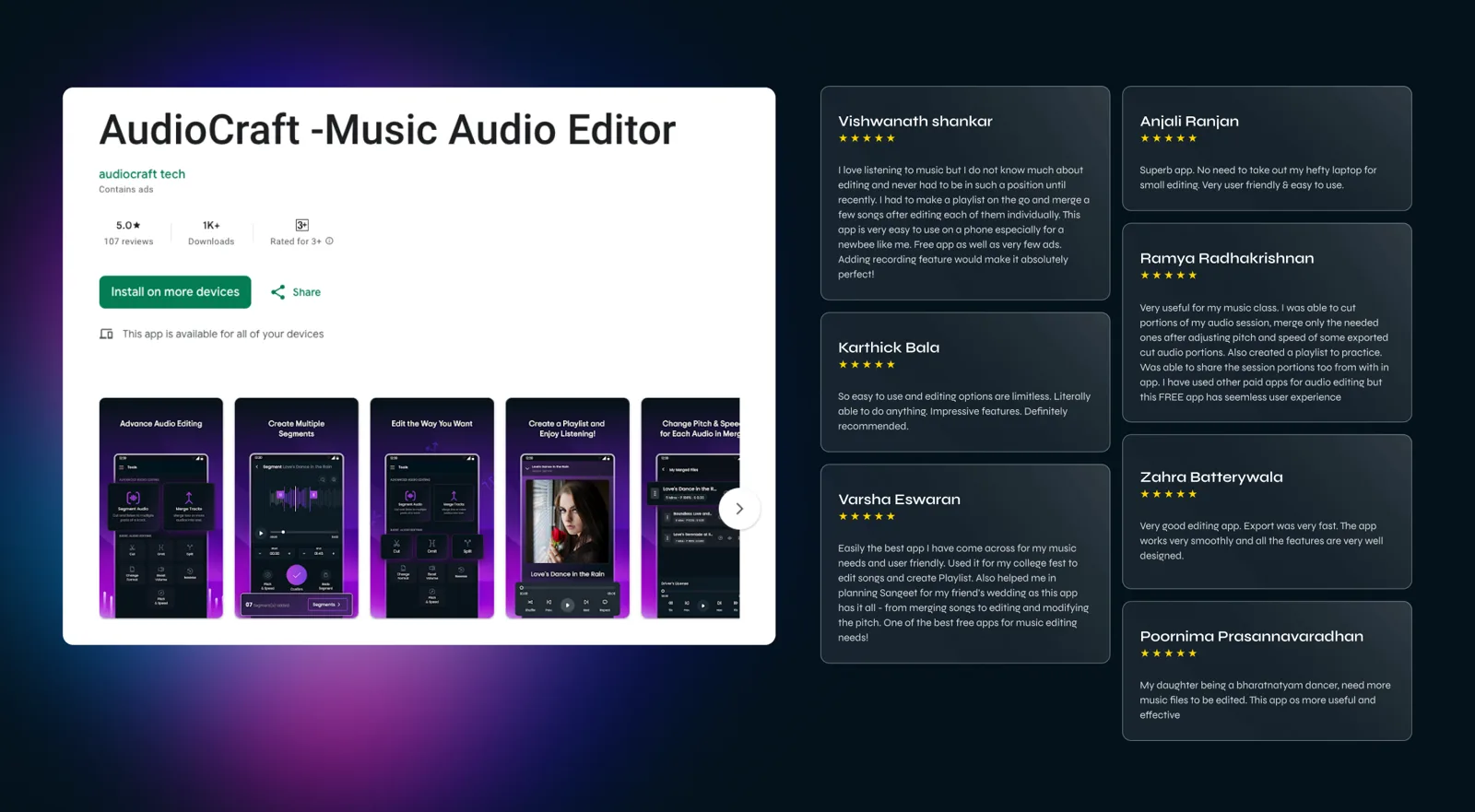
- As of October 2026: 4,500+ downloads · 650+ monthly active users · 100+ five-star ratings · $0 spent on acquisition
In short
- ProblemMusic students record long lessons but practice in short sections, and phones had no good way to split, name and loop those sections.
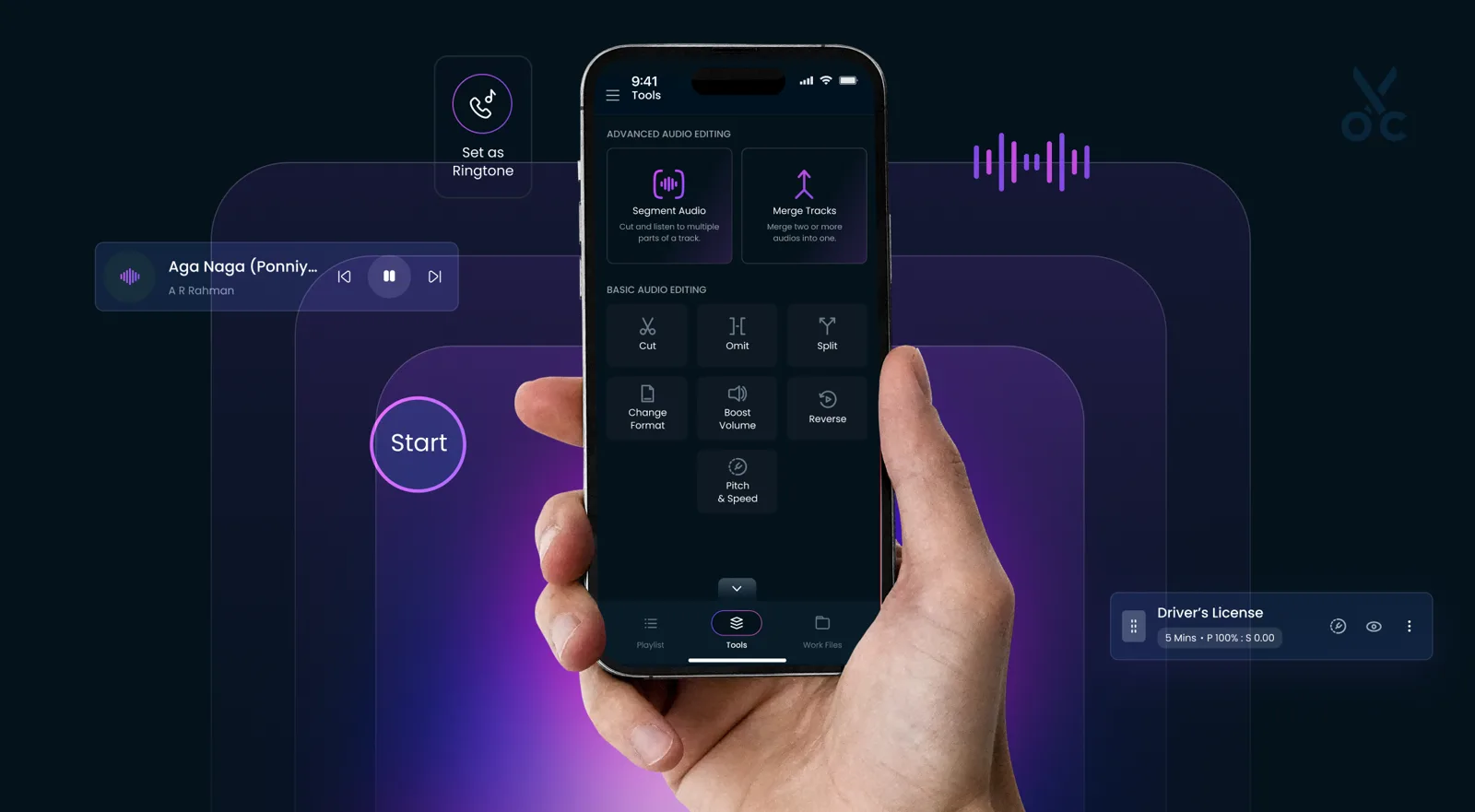
- What I didDesigned and shipped an app built around segments: many named practice sections from one recording, stored without duplicating audio, plus merging tracks with per-track pitch and speed.
- Result4,500+ downloads and 650+ monthly users with no marketing spend. And one clear lesson: niche products need niche positioning.
Where it started
I'm a trained Carnatic vocalist. Carnatic is South Indian classical music, learned largely by ear from a teacher, so most students record their lessons, often 30–60 minutes long, and practice from them.
But practice doesn't work like listening. You don't play a 45-minute recording from start to finish. You find the two minutes where your teacher demonstrated a phrase, loop it, and drill it until it sticks. On a desktop that's easy. On a phone, where practice actually happens, it was painful.
What existed
I reviewed the top audio editing apps on Google Play. They solved the same jobs (trim, merge, convert), and the two features closest to what learners need both fell short.
| Bookmarks | A–B loop | AudioCraft segments | |
|---|---|---|---|
| Marks a start and an end | Start only | Yes | Yes |
| Many sections per recording | Yes | One at a time | Yes |
| Named and saved for next time | Partly | No, redone each time | Yes |
| Plays hands-free while you practice | No, you stop it manually | Yes, one loop | Yes, in sequence |
Nothing let a learner turn one long recording into a set of named practice sections and play through them without touching the phone.
Key decisions
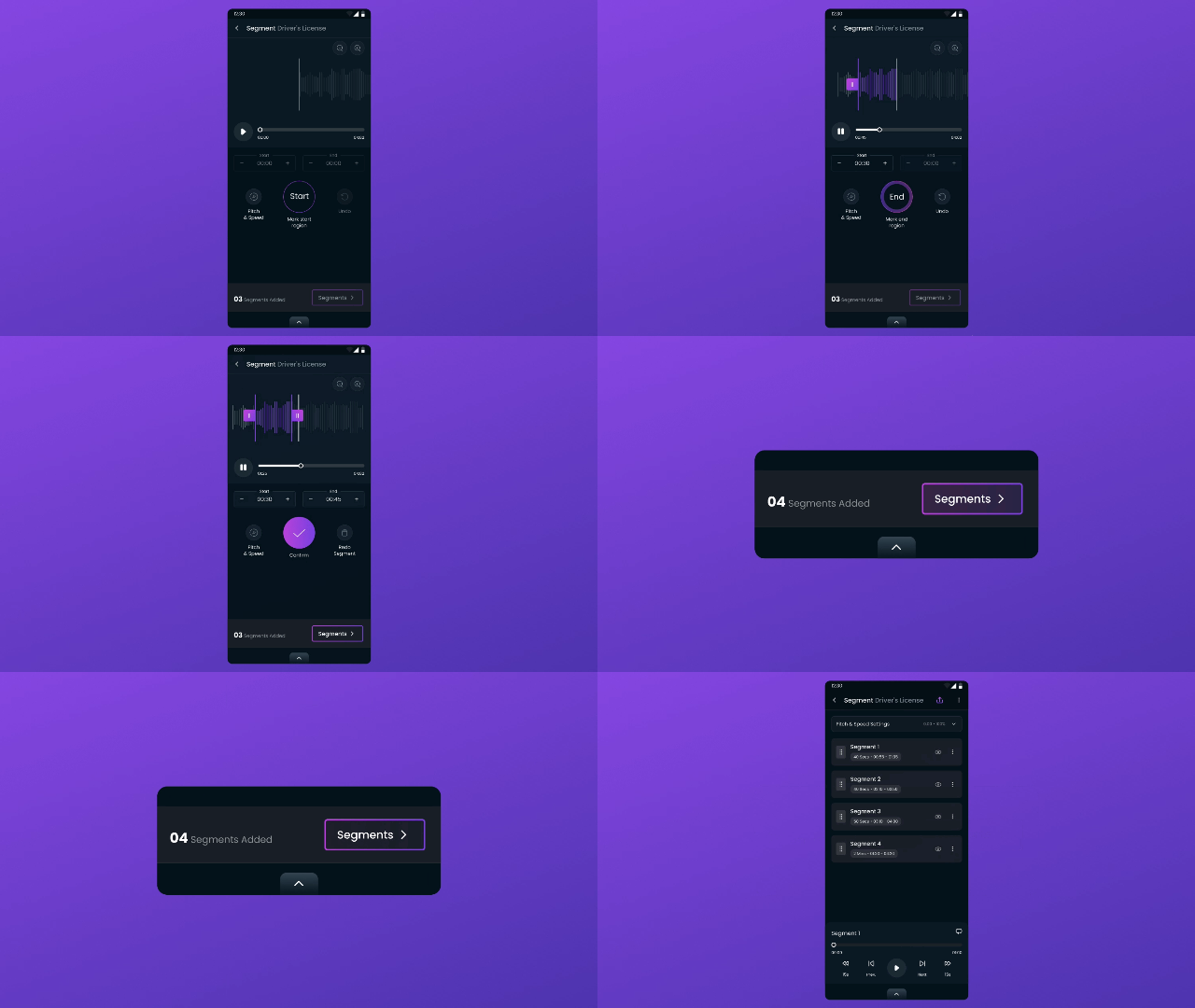
01Make segments the core of the app
- Options
- Build another audio editor with a loop feature, or build the app around segments.
- I chose
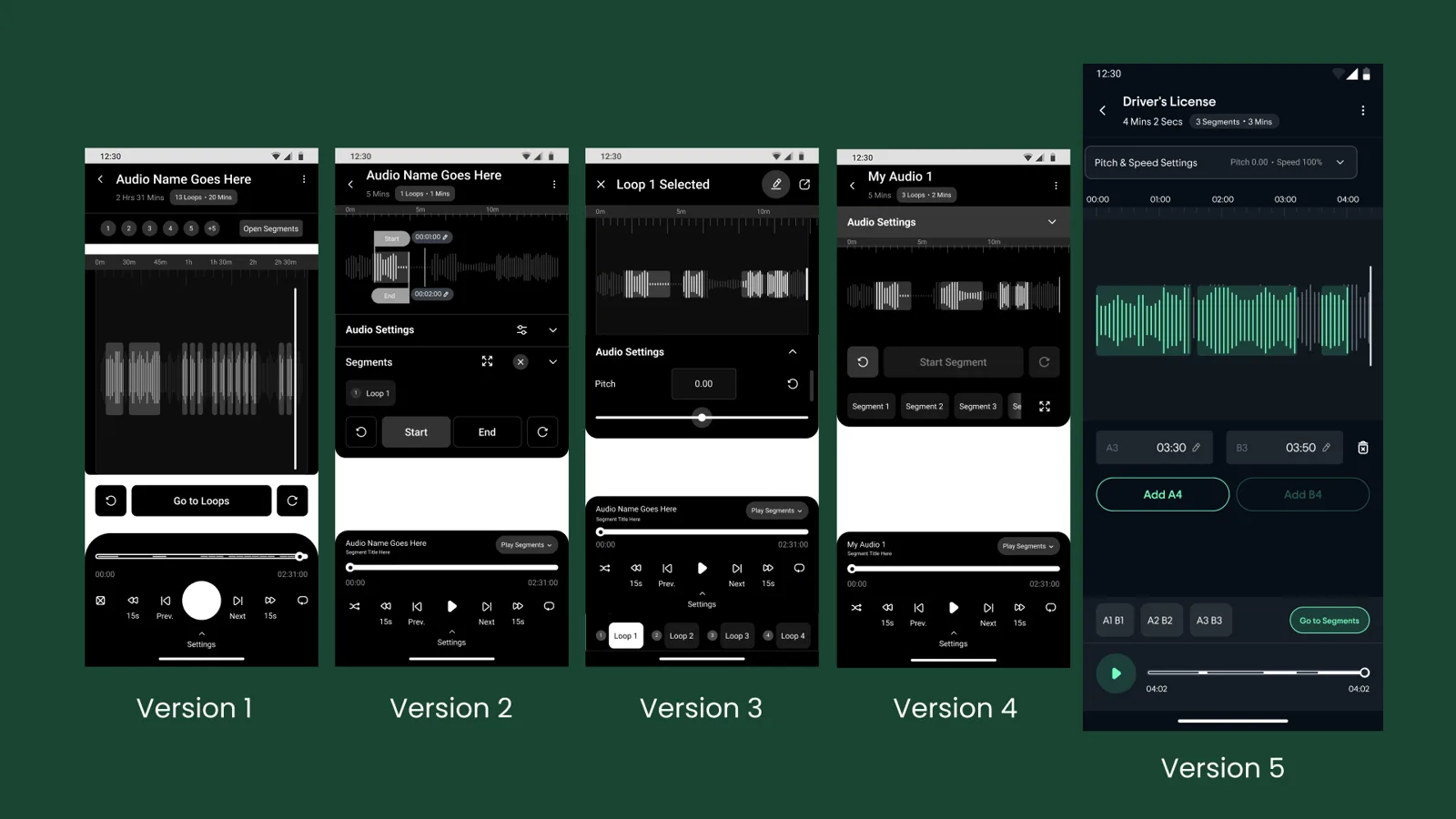
- Segments first. A recording becomes a playlist of practice sections, with editing tools around it.
- Why
- That was the job no existing app did well, and the reason a learner would switch.
- Trade-off
- A narrower story to tell. That tension came back when I positioned the app.
02Store segments as references, not new files
- Options
- Export each segment as its own audio file, or save only its start and end points.
- I chose
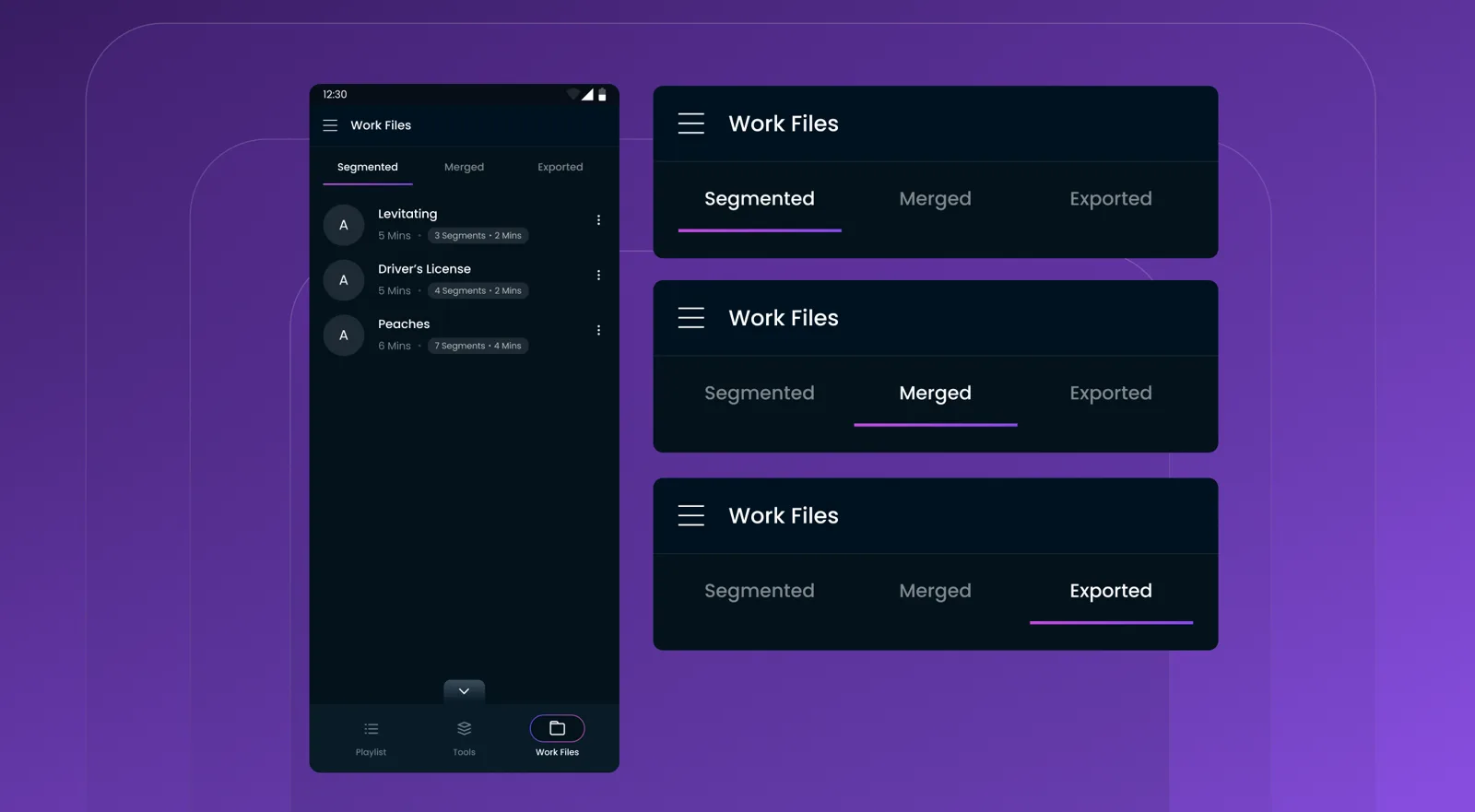
- Save start and end points as metadata in "work files" that point to the original recording.
- Why
- A 45-minute lesson is about 40 MB. Ten exported segments would use ten times the storage for the same audio. As references, users get unlimited segments at almost no cost in space.
- Trade-off
- More engineering work, and it needed close collaboration with the developer to get right.
03Don't use AI to find segments automatically
- Options
- Have AI detect and suggest segments, or let learners mark their own.
- I chose
- Learners mark their own.
- Why
- Which sections matter depends entirely on the learner. One student needs to drill the opening phrase; another needs the closing variation. It's a workflow problem, not a detection problem.
- Trade-off
- Learners do a little manual work for each recording.
04Replace "A–B" with plain words
- What I saw
- My first design used the "A–B" labels from music software. I tested it with about 25 musicians and 15 general users. Musicians understood it immediately; general users didn't know what A and B meant.
- I changed
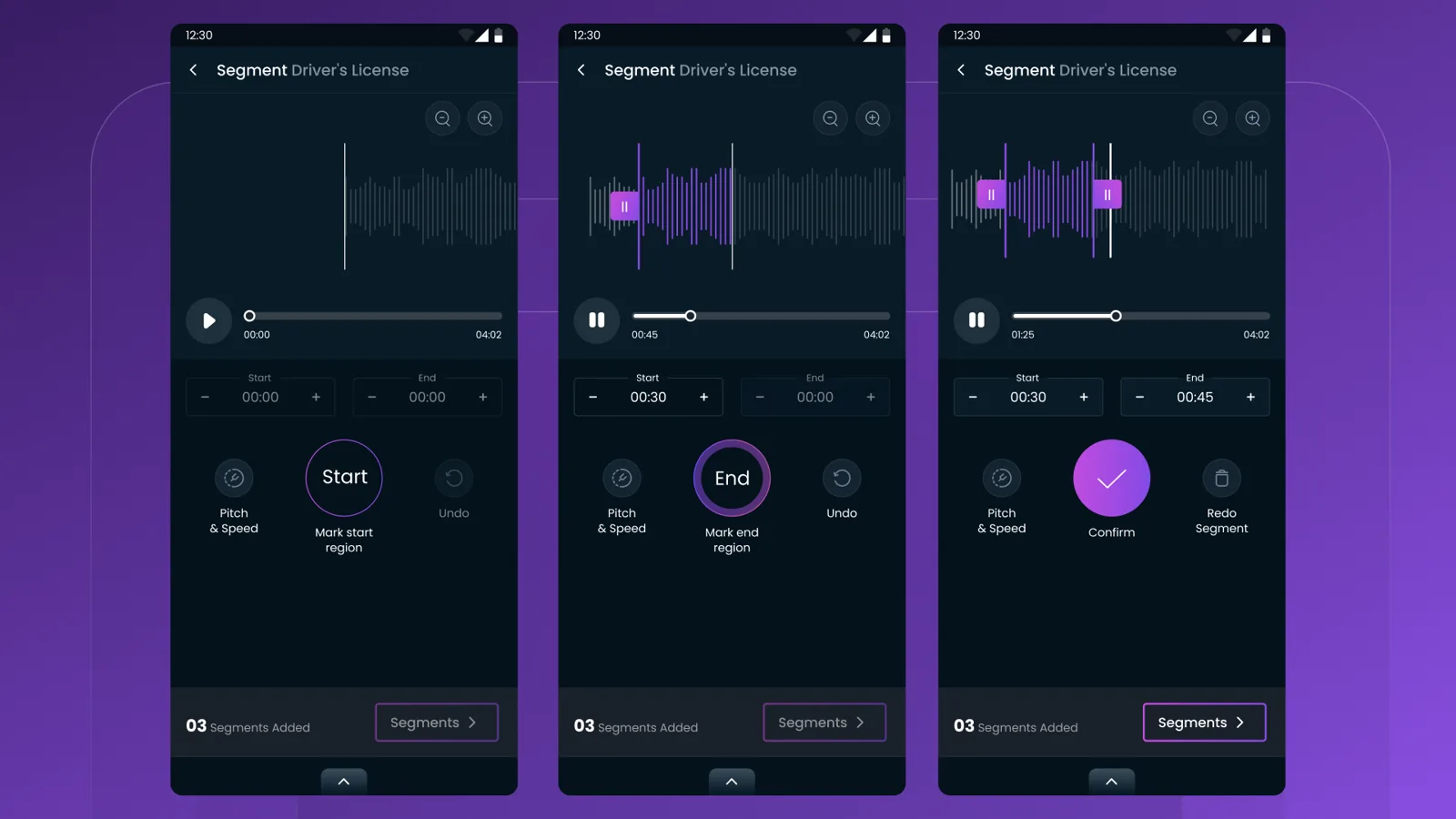
- Segment creation became "mark start, mark end, name it", with the A–B labels removed entirely.
- Result
- Task completion improved in both groups, and the app became usable for people who aren't trained musicians.
Launch and the positioning trap
I spent nothing on marketing and relied on App Store optimization and organic search.
To get more downloads, I positioned AudioCraft as a general "audio editor" rather than a "music practice tool". The logic was sound on paper: more search keywords, more visibility, more installs. It worked, but it attracted the wrong people.
- Downloads grew, but most new users wanted basic trimming and merging.
- Segmentation, the feature that made AudioCraft different, was buried behind generic branding.
- The musicians it was built for couldn't easily find out it solved their exact problem.
I optimized for volume over fit.
Results
| Measure | As of October 2026 |
|---|---|
| Total downloads | 4,500+ |
| Monthly active users | 650+ |
| Five-star ratings | 100+ |
| Acquisition cost | $0 |
About one in seven people who ever installed AudioCraft still use it every month, with no paid acquisition behind it.
I can't yet see whether the same people return each month or whether new users replace those who leave, how many people use segmentation versus basic editing, or whether my regular users are the musicians I built for. I suspect they are, but I haven't confirmed it.
Looking back
What worked
- The core insight was right: music learners need better mobile tools for practice.
- Storing segments as references kept the app light and made unlimited segments possible.
- Dropping the A–B labels opened the app to people without music training.
What didn't
- I built for a niche and marketed to everyone, so downloads rose but fit didn't.
- I didn't add analytics in the first version, so I can't answer basic questions about how segmentation is used.
- I haven't tested whether people would pay, and there isn't enough volume for ads to matter.
My next bet
I'm repositioning AudioCraft as a music practice tool with editing built in, instead of an editor with practice features. Fewer people may download it, but the right people should find it, stay, and be more likely to pay. If the repositioning works, splitting it into a free editor and a paid practice app is the next option, though that means two apps to maintain.
The first step is small: rewrite the store listing around practice and measure whether new users stick around better.