YourTribe · Employer Profiles
Cutting startups' time to first candidates from 2–3 months to 3–5 weeks
Founders thought they were losing talent on salary. Interviews showed candidates simply couldn't judge them. I redesigned company profiles around founder credibility instead.
- My role
- Design lead. I ran the research interviews, set the product strategy, built the design system, designed the core workflows and wrote the UX copy. Two junior designers built variant screens from my direction.
- Team
- Me, 2 junior designers, 2–3 engineers
- Timeline
- 2–3 months
- Product
- Web · YourTribe, a two-sided hiring marketplace for early-stage startups in India
- Results
- 3–5 weeks to first résumés, down from 2–3 months · +35% applications in 3 months · 5,500+ startups listed within 6–8 months
In short
- ProblemEarly-stage startups struggled to attract good candidates, and founders blamed the salaries they couldn't match.
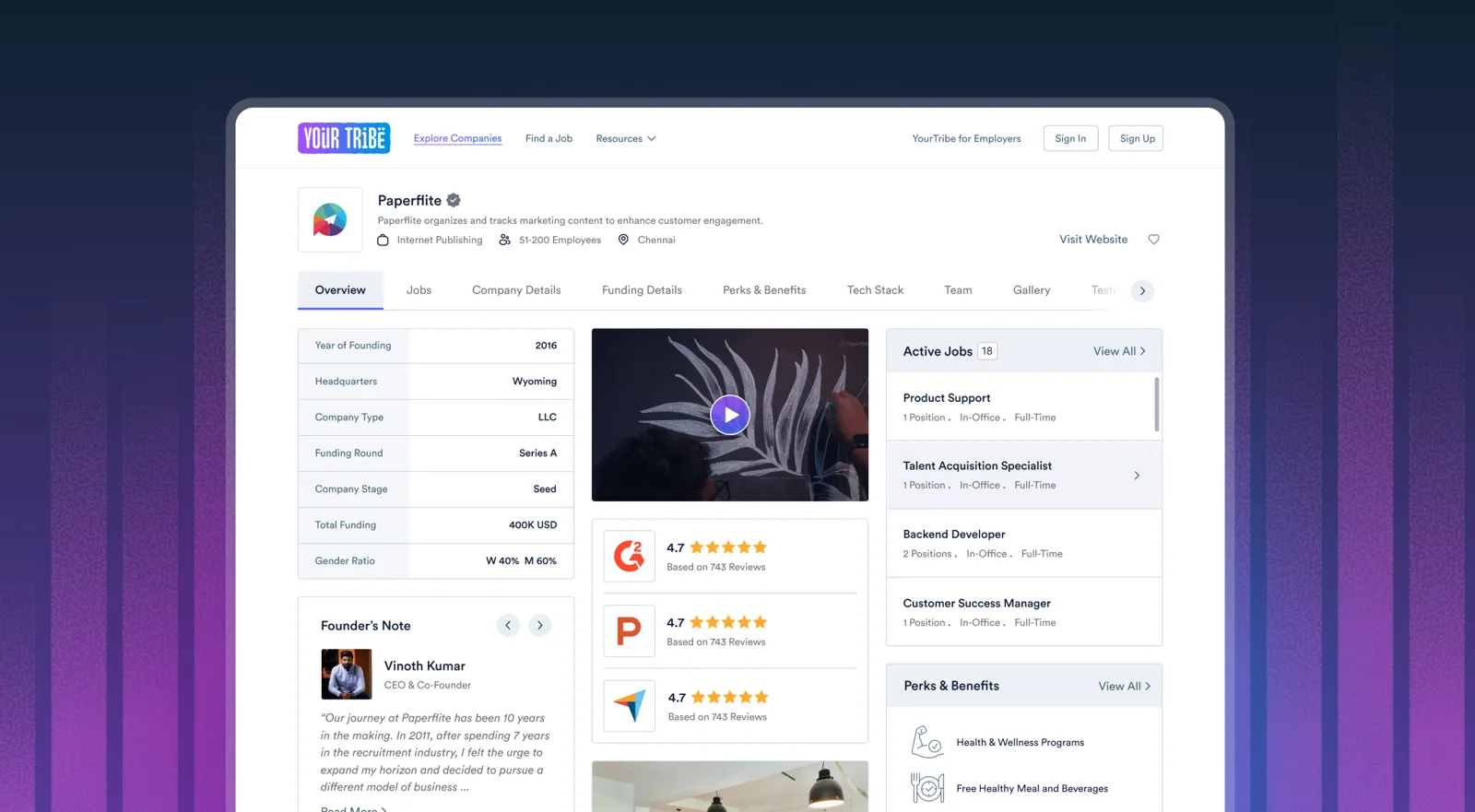
- What I didResearch showed candidates had no way to judge a young company, so I designed profiles that lead with the founders' track record and what the role really involves, in one standard format candidates can compare.
- ResultStartups started getting relevant résumés in 3–5 weeks instead of 2–3 months, and applications rose 35% in the first three months.
The problem
Early-stage startups in India find it hard to hire well. On the surface it looks like a pay problem: startups can't match what large companies and multinationals offer. But treating it as a pay problem leads to a game startups can't win.
If salary were the only barrier, no startup would ever hire anyone good. Some do. I wanted to know what was different about them.
What we learned
I interviewed two groups: early-stage founders, and job seekers at different career stages.
Founders told us the same thing again and again: "We lose candidates because we can't offer competitive salaries." Job seekers described something else.
| Job seekers | What they assumed | What frustrated them |
|---|---|---|
| New graduates | "I need a big brand name for my first job to be safe." | They ended up doing low-impact work despite being skilled. |
| Mid-level | "Startups are risky and underpay." | They saw only the risk of joining a startup, not what they could gain. |
Both sides were optimizing for the wrong thing. Founders were competing on salary. Candidates were defaulting to brand safety. Neither was asking the question that mattered most:
Where will I actually grow?
The reframe
I stopped treating this as a compensation problem and treated it as an information problem. Startup websites are built to win customers, not candidates. A job seeker visiting one finds product information, but can't answer the questions that decide whether to apply: Who are the founders? What have they done before? What would I actually work on? Is this team credible?
Without answers, candidates fall back on the safe choice, a brand they recognize. At an early-stage startup, the founder is the company, and their track record is the strongest proof the company has. That became our hypothesis: if startups present their credibility instead of competing on salary, they'll attract candidates who value growth over safety.
Key decisions
01Lead with the founder, not perks and culture
- Options
- A culture-led profile with photos, perks and values, which is what most job boards show; or a profile led by the founders' background and what the role involves.
- I chose
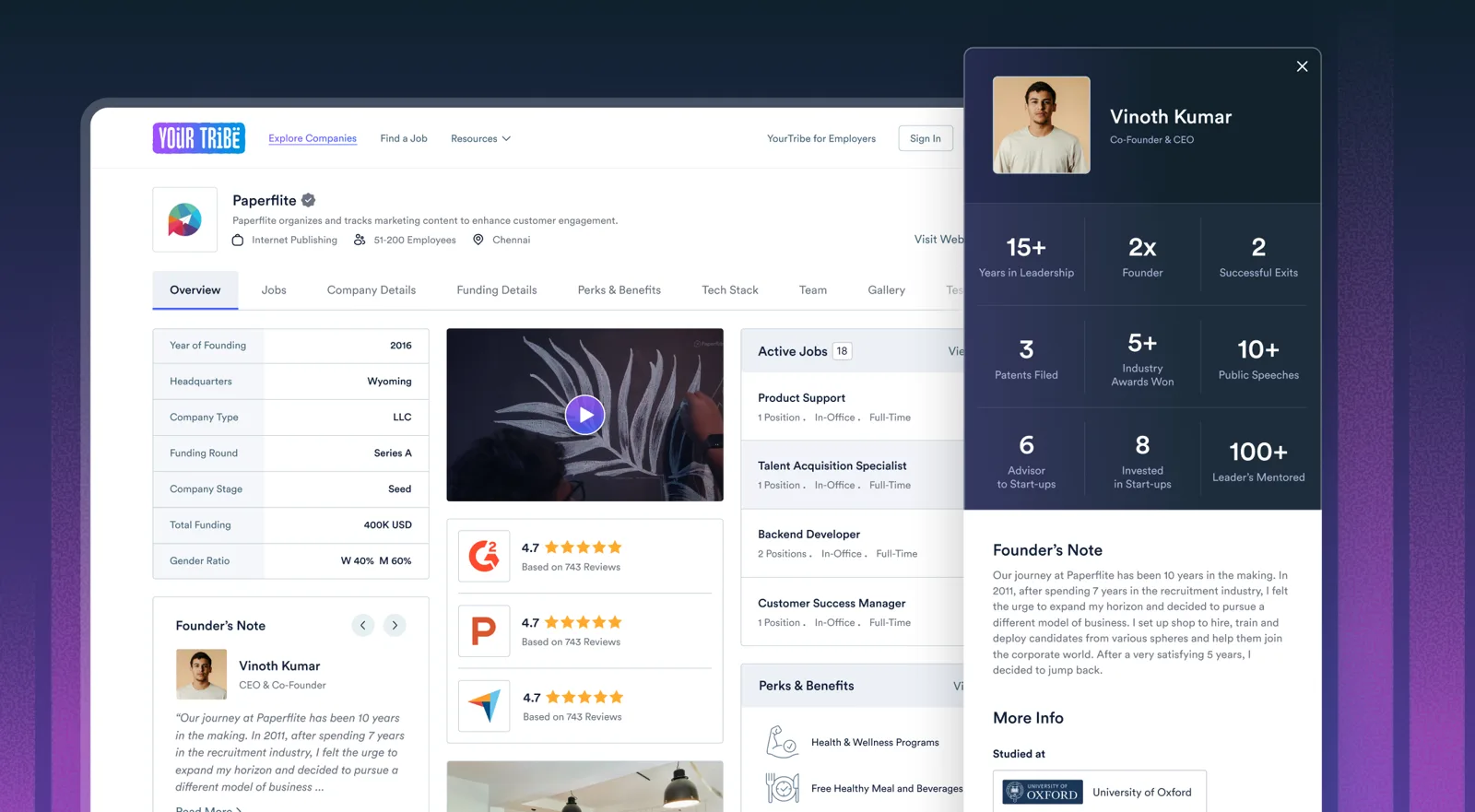
- Founder first. Their experience, previous companies and expertise appear as the main proof point, not in a buried "About" section.
- Why
- At an early-stage startup, the founders' track record is the proof candidates were missing. Perks don't tell them whether the team is credible.
- Trade-off
- Profiles depend on founders being willing to share their history, and there's less room for culture storytelling.
02One standard structure, not custom pages
- Options
- Free-form pages that each startup designs, like a careers site; or one consistent structure for every company.
- I chose
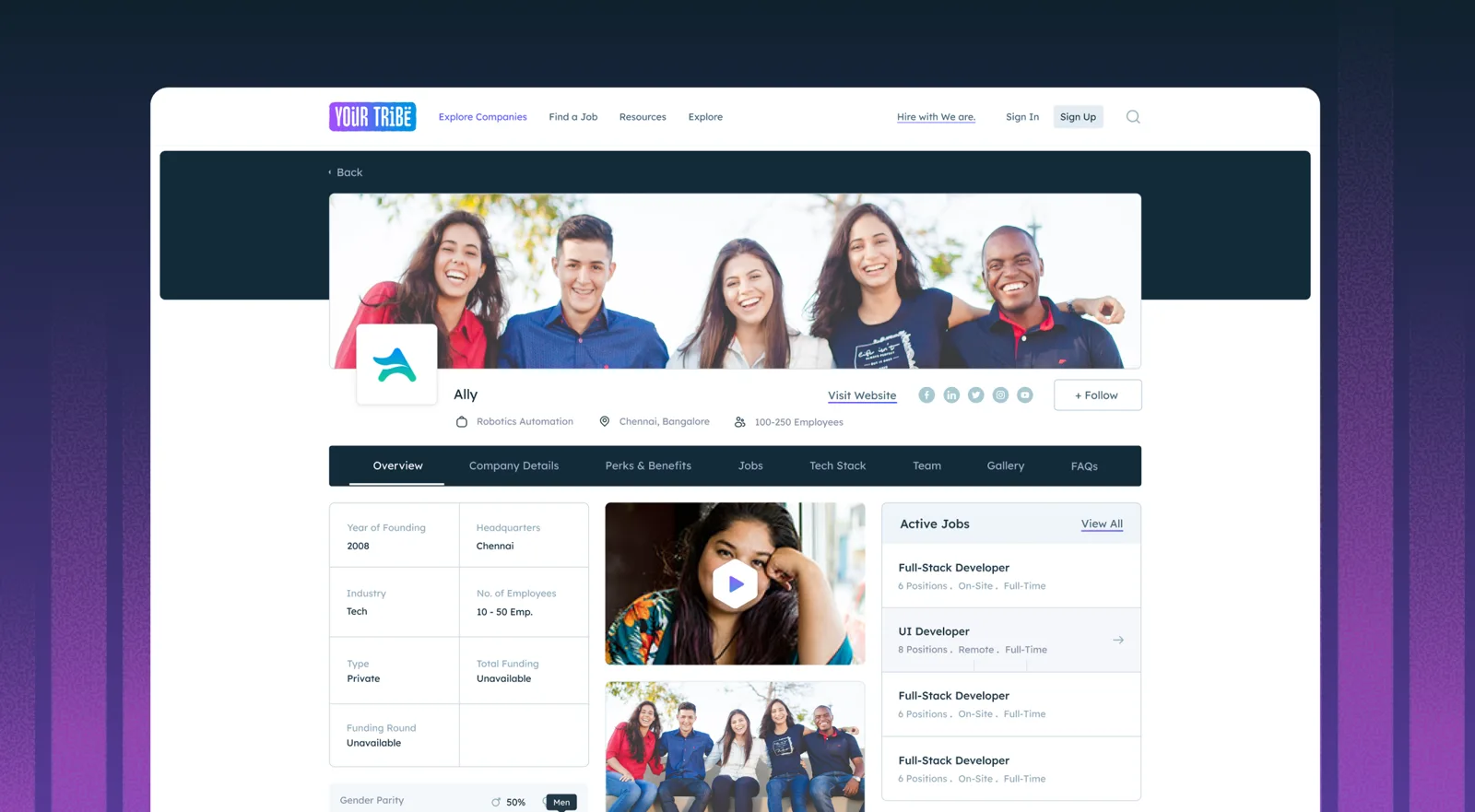
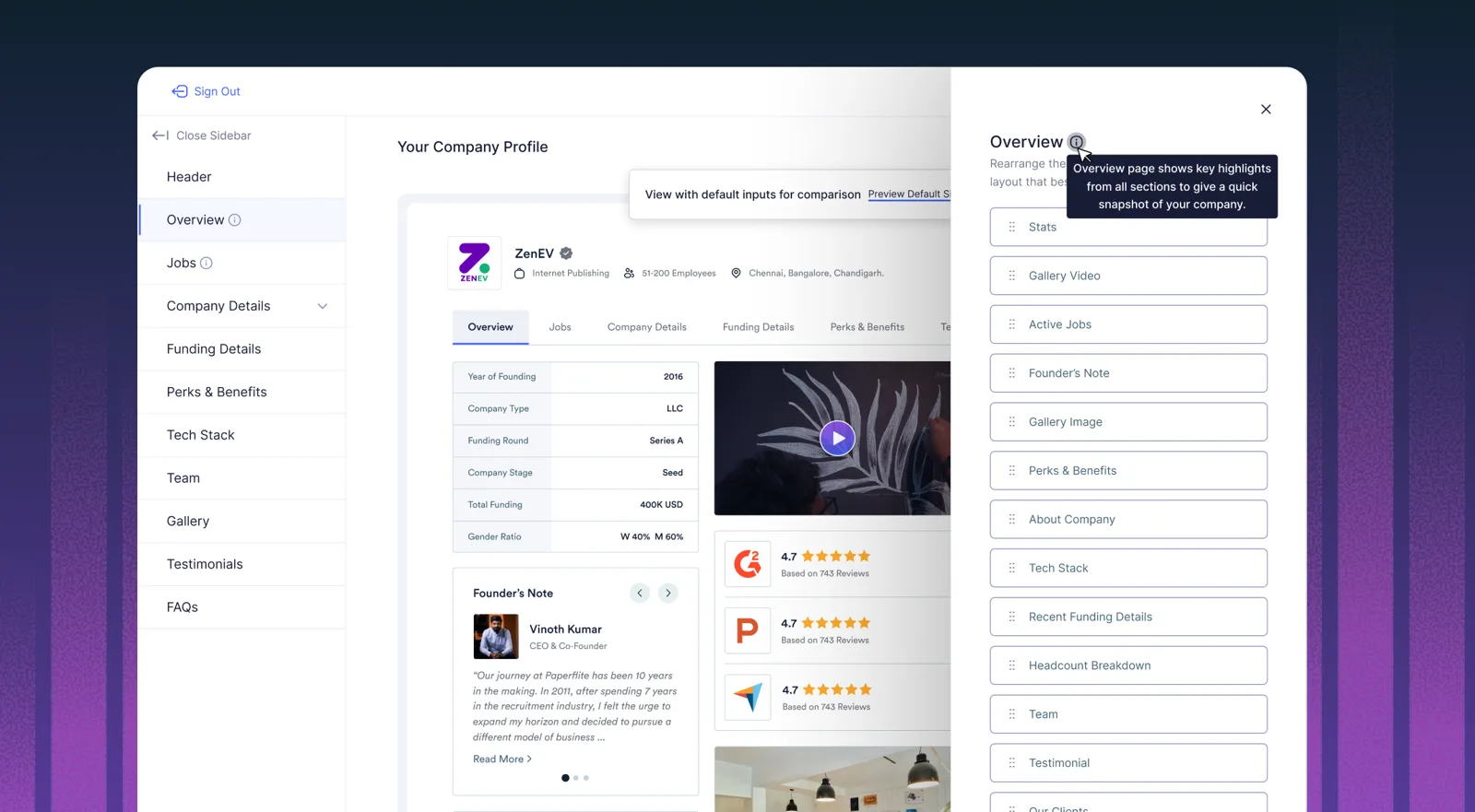
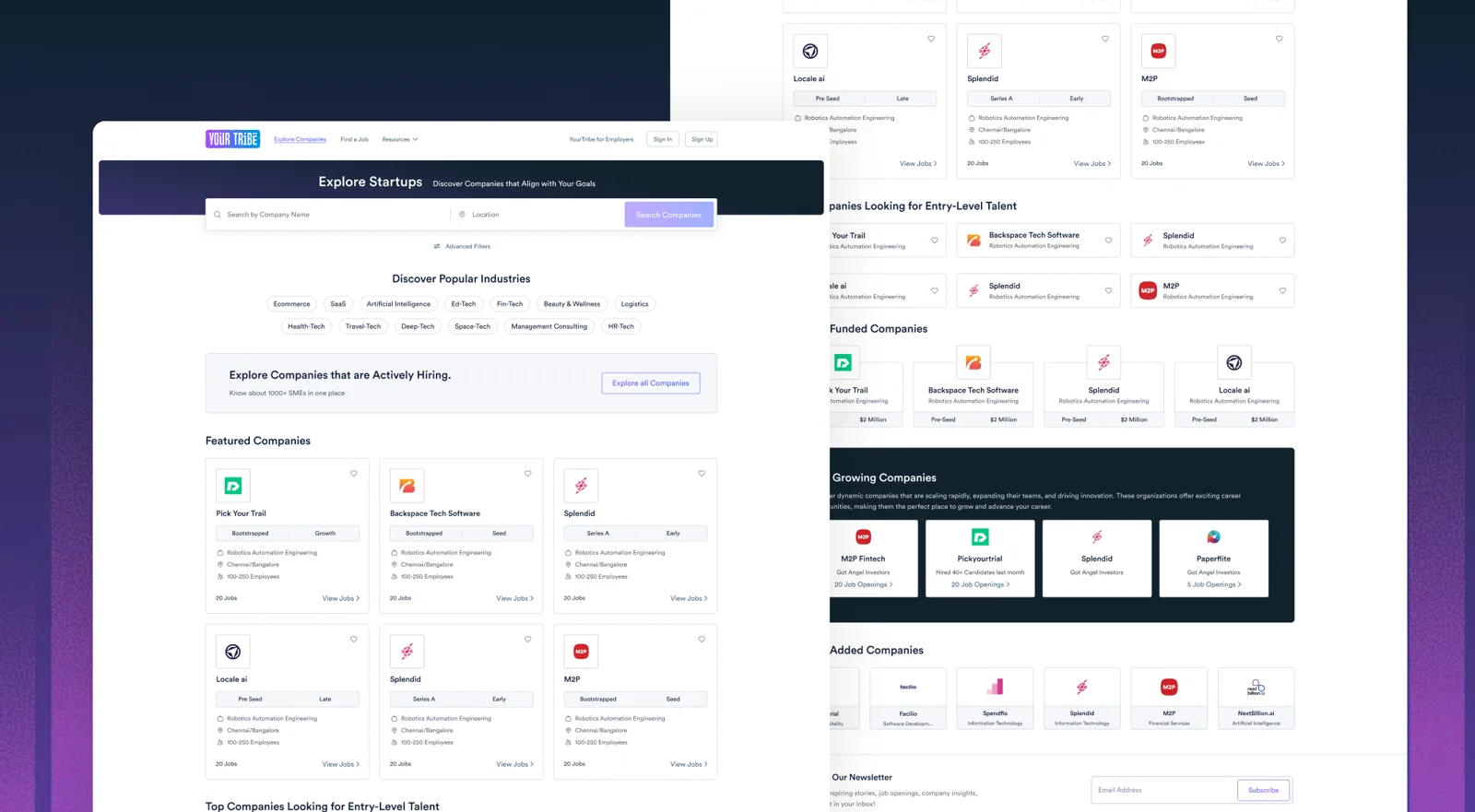
- A standard structure with the same sections in the same order: stage, funding, founders, role clarity, team.
- Why
- Candidates compare several startups at once. A consistent layout cuts the effort of comparing, and structured fields let us build search and filters on top.
- Trade-off
- Startups give up visual expression. I judged consistency to be worth more to candidates than individuality.
03Leave salary benchmarks out on purpose
- Options
- Show salary bands and market benchmarks next to each role, or leave them out of the profile.
- I chose
- Leave them out, along with generic culture content like perks and office photos.
- Why
- Benchmarks would put salary back at the center of the comparison, the one area where early-stage startups almost always lose.
- Trade-off
- Candidates who care most about pay get less to go on up front.
The solution
Results
| Measure | Result | Compared with |
|---|---|---|
| Time for a startup to receive relevant résumés | 3–5 weeks | 2–3 months before |
| Profile views | +42% | 3 months after launch vs. the 3 months before |
| Job applications | +35% | Same period |
| Apply rate, complete vs. incomplete profiles | 1.8× | Complete profiles vs. incomplete ones |
| Startups listed | 5,500+ | Within 6–8 months of launch |
The 1.8× gap supported the hypothesis that missing information, not salary, was the main blocker. It's a correlation, though: stronger startups may both complete their profiles and attract more applicants. I treat it as supporting evidence, not proof.
Looking back
What worked
- Founders understood "lead with your credibility" as something they could act on, not just a slogan.
- The standard structure made comparing startups easier, and gave us the data to build search and filters.
What didn't
- Founders rarely set up profiles themselves. Most profiles were created by our team and then claimed by founders. Self-serve setup stayed a friction point.
- We skipped testing competing hypotheses because of time. The bet paid off, but the process was riskier than it should have been.
What I'd do differently
- Test the founder-credibility idea with a lighter version first, before building the full profile system.
- Design the founder activation flow earlier, so self-serve setup grows with the marketplace.
What it led to
Because we delivered good candidates, founders started trusting us with problems beyond hiring, like legal, compliance and trademarks. That pattern shaped the company's next strategic move: growing from a hiring marketplace into a broader platform for early-stage founders.